to optimise processes
to optimise processes
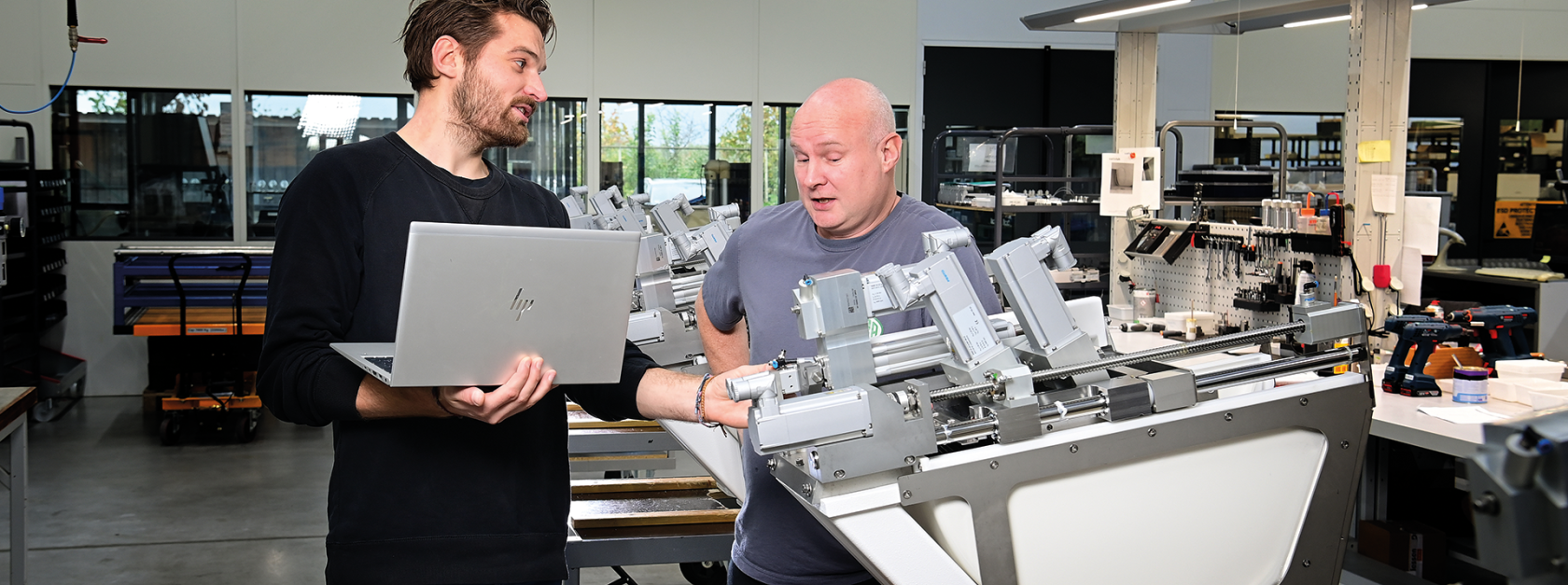
Immersed in a world of precision and innovation, Dorus van Vliet (34) is Co-Engineer at Nijdra. He grew up in Middenbeemster[J Z 1] , but only got to know Nijdra by accident – after spontaneously attending an open day. Now, he's responsible for designing, managing and continually improving technical processes and assembly. We talked to Dorus about curiosity, the pleasure of puzzling and his ambition to prepare Nijdra for future growth and specialisation.
Dorus, can you tell us how you came to work at Nijdra?
“Certainly. I have a background in mechanical engineering, which I studied at Amsterdam University of Applied Sciences. After graduating, I started work at a firm of consulting engineers, and worked mainly behind a desk. After a while, I became a bit bored with that. One weekend when I was home, my dad mentioned there was an open day at Nijdra, here in our village. He knew it was a technical company and wondered whether it was something for me. So, after lunch, I got on my bike and rode to the business park.”
And you liked what you saw?
“Dennis van Dijk showed me round. At the start of the tour, he asked about my technical background and adapted his explanations accordingly. I recognised much of what he told me and what I saw. Back at the start, Dennis introduced me to Ton ten Bosch, who, at the time, managed the planning department. Our conversation was different from anything I’d experienced before: instead of me having to sell myself, they were trying to convince me to come and work at Nijdra. After mulling things over, I spent a ‘try out’ day in the company, and that's how I rolled into this job.”
Did you know of Nijdra before the open day?
“Yes and no! I was born here and went to school in Middenbeemster. Funnily enough, I didn't actually know what Nijdra did. Everyone knew the name, it was in big letters on the building, but what went on inside was a bit of a mystery. When I was at school, we all knew there was a chocolate factory, a sports hall, and Nijdra. But what the big company actually did was – and still is – often unclear to outsiders. Which is a great shame, because if I’d known earlier, I’d have been knocking on the door for a summer job here while studying.”
How long have you been working at Nijdra?
“I started here a few years ago, in the summer of 2022[J Z 1] . I was taken on as planner/process engineer. My duties have expanded – now I'm really a co-engineer. We're reorganising the department a bit and we're looking for some new colleagues.”
Can you describe what your job actually entails?
“It’s a very varied job. I actually supervise all technical aspects within the company. These include supporting various departments, such as sales, purchasing and assembly in particular. When a new project comes in, we check whether we can make it with the expertise and tools we have. We discuss the complexity with the client, we review the specifications and sometimes we have to look for alternatives, for example if a supplier can't provide exactly what we want. An important part from my work is supervising the assembly processes. I write the work instructions, train the engineers, and I decide whether we need any special tools or tooling for the project. The goal for every project is: how can we make a product as efficiently and flawlessly as possible, from the initial proposal phase to the finished product.”
Does your work include much contact with clients?
“Yes, more and more. And especially for new products, I get involved in discussions with clients early on. Together, we consider how feasible it will be to manufacture and sometimes we suggest design tweaks to make production more efficient. If a client comes to us with an existing product and wants us to make part of it, we won't be so intensively involved.”
What kind of clients receive such detailed attention?
“Our clients include large companies like ASML, but also smaller, young companies and start-ups. A good example is a start-up in Delft that develops orthoses. I also help these young companies with related matters, such as managing the technical drawings, preparing specifications and supervising modifications. Often, they've just graduated and they don't know how such processes work. I really enjoy being a bit of a coach for them.”
Can you tell us about a project where your expertise really made a difference?
“Of course! What I really love is supervising complex assembly processes. Recently, I chopped up the entire assembly process for a large machine into digital steps, with illustrations. The engineers could then see exactly how everything should be put together, for example: where to apply glue and what needs particular attention. As part of this, I devised some special tools to make the assembly process smarter and more efficient, and to reduce the chance of making mistakes. Solving these puzzles is really satisfying.”
What makes your work at Nijdra so interesting and unpredictable?
“It's very varied. Every client and every product is different. Sometimes you run into complex tolerances or awkward constructions, then you really have to think carefully about the best approach and sequence. Sometimes it's the assembly process that's challenging or there's a test procedure to develop that not only meets the client's requirements, but is also practical for us too. You never know what's coming next, and that's what makes it such fun.”
How do you involve the client in the process, and where do you draw the line with what you share?
“Some things are just our expertise, tricks of our trade. We often try to optimise processes. Sometimes we even adjust the assembly sequence the client originally devised. We don't necessarily involve the client, because this is our added value. But if we run into problems during production – for example, something doesn't fit properly or a drawing isn't quite right – then of course we involve the client so we can find a solution together. New projects always mean intensive contact, for ongoing projects our clients rely on our judgement and expertise.”
Can you tell us about the practical aspects of your contact with clients?
“Once a project is under way, I often have direct contact with the client's technical people. The purchasing department no longer needs to be involved, just engineer to engineer. This works well because we can bounce ideas around, give each other feedback and quickly get to the best solution together. When working with young companies and start-ups, I also help them set up their processes, so they understand what we expect from them and how they can best tell us about technical changes.”
Do you have any particular ambitions for the future?
“Yes, I do. What I really would like is to take the assembly work at Nijdra to the next level. More clients, greater specialisation, and particularly in clean room assembly. That's a good direction, because that market is growing fast, especially in the Netherlands and Europe. If we want to maintain our position at the highest level, we must continue to innovate and invest. My ambition is to play a major role in this, so we at Nijdra can truly make the difference with our specialised, high-quality assembly processes.”
[J Z 1]I’ve changed this so it’s not time dependent like the original, and Dorus’ age is mentioned at the beginning.
‘Ik ben nu 34 jaar en werk hier sinds twee jaar dus ik ben in de zomer van 2022 begonnen.